
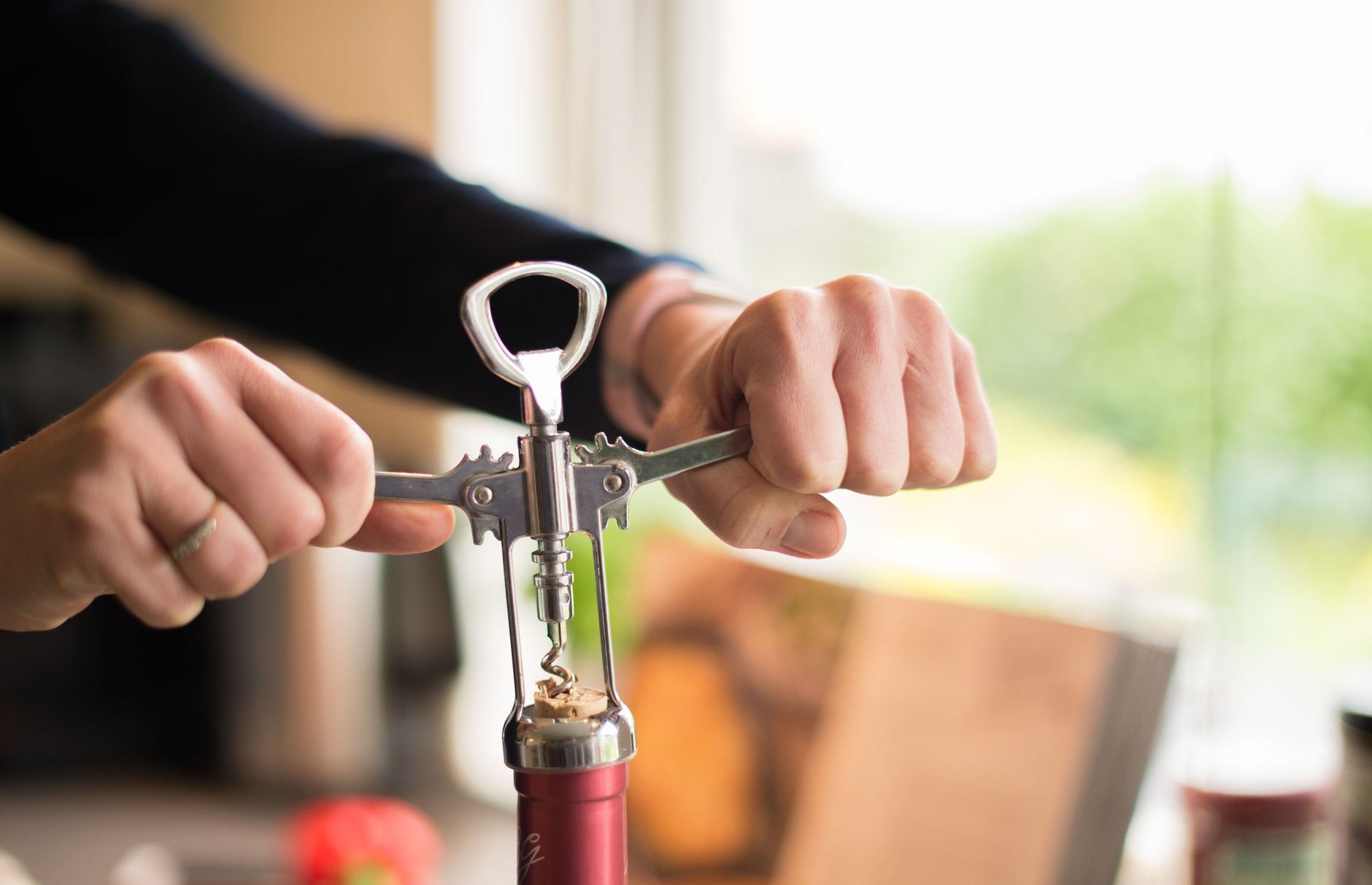
To use a wine opener, cut the foil below the lip of the bottle, push the tip of the corkscrew into the center of the cork, turn until most of the spiral is inside, then lift the cork out straight. That last step is where the types differ: a waiter’s corkscrew uses a lever resting on the rim, a winged corkscrew uses its two arms, a lever model does it in one pull, an electric opener does it with a button and an air-pressure opener pushes the cork up with gas.
The steps below follow what the makers and Wine Enthusiast publish for each type. We visited the listings on amazon.com in October 2026 to check the instructions, and we link to everything at the end. If your opener came with its own instructions, those come first.
How do you cut the foil?
Cut it just below the lip, the raised ring at the top of the neck. Wine Enthusiast recommends cutting under that lower edge because frayed foil that touches the wine as you pour can taint it. With the small knife on a waiter’s corkscrew, slice halfway around the neck, go back to the starting point and cut the other half in the opposite direction, then make one short vertical cut up to the top and peel the capsule off.
A separate foil cutter is easier. On the Boomerang two-step corkscrew, for example, the cutter has four small wheels: you open it, place it over the neck, turn it and lift it off with the top of the foil inside. The OXO lever corkscrew has a removable cutter that works the same way: squeeze both sides against the top of the bottle and turn.
How do you use a waiter’s corkscrew?
Hold it like a T with the spiral, called the worm, pointing down between your fingers, and put the tip in the center of the cork. Then:
- Turn the corkscrew into the cork, pressing down gently at first so the tip bites. Keep the worm straight rather than at an angle.
- Stop when about three quarters of the worm is inside. Wine Enthusiast uses that as the guide; Franmara says to leave about half a turn showing on the Boomerang.
- Fold the lever down so its notch rests on the lip of the bottle, and hold it there with one hand.
- Lift the handle with the other hand. The lever pulls the cork up.
- On a two-step corkscrew, move to the second notch once the first lift is done and pull the rest of the cork out. Franmara says the first notch on the Boomerang raises the cork about 7/8 of an inch.
- Twist the cork off the worm by hand.
The two-step lever is the reason most people find these easier than the old single-hinge keys. Two short lifts keep the cork straight, and a cork pulled at an angle is the one that snaps halfway.
How do you use a winged corkscrew?
This is the one with two arms that rise as you turn the handle, and the easiest manual opener to learn. Hold the body on the neck of the bottle with the arms down, turn the handle on top until the arms are fully raised, then press both arms down at the same time. The cork comes up with them. Turn the cork off the screw afterwards.
If the arms stop rising before they reach the top, the screw has gone through the whole cork. That is fine with a long cork, but on a short one it can push crumbs into the wine, so stop turning as soon as the arms are up. Gorilla Grip’s winged opener has an open, pointed spiral and lists itself as top-rack dishwasher safe, which few corkscrews are. Most metal and wooden ones should be wiped clean instead.
How do you use a lever corkscrew?
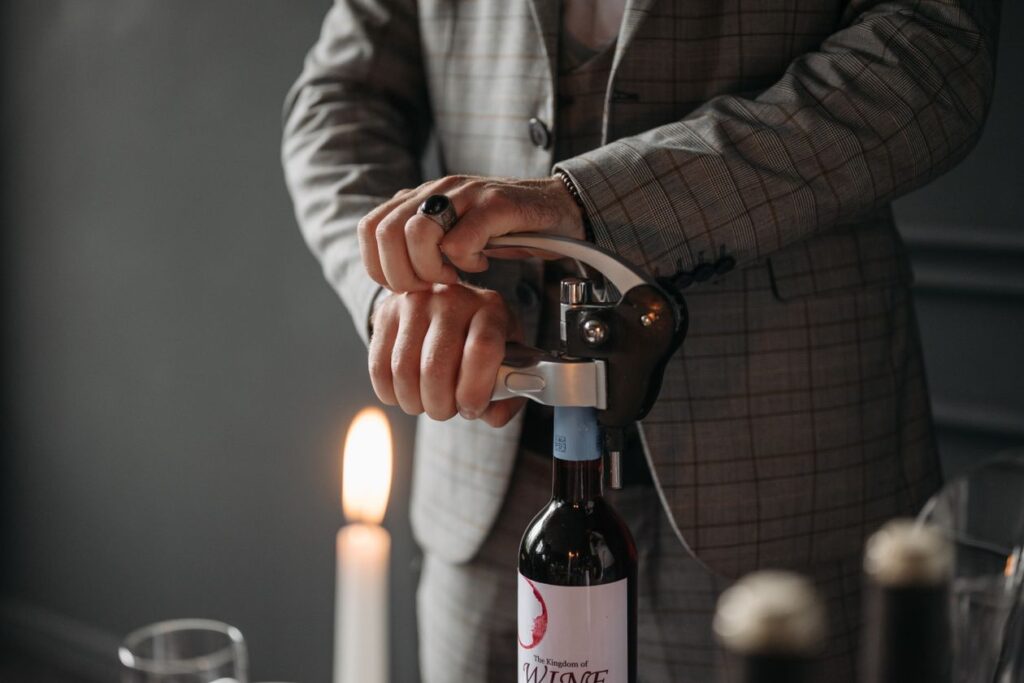
Lever openers, often called rabbit corkscrews, do the whole job in one motion. With the OXO steel model, the instructions on its listing are: put it on the bottle, squeeze the handles, then pull the lever down and back up, and the cork is out. One more pump of the lever releases the cork from the worm.
Two things to know. The worm has a non-stick coating so it slides into the cork, and OXO includes a spare worm in the box. And a lever opener needs to sit square on the neck, so very wide or unusually shaped bottles can be awkward. We tried to read OXO’s own product page for more detail, but it no longer loads, so the steps here come from the Amazon listing.
How do you use an electric wine opener?
Cut the foil first, then stand the opener on top of the bottle and press the button. Chefman describes its model this way: place it on top of the bottle, press one button and the cork comes out in seconds.
Check the power before you buy. The Chefman runs on four AA batteries, which are not included, while other models charge on a base or by USB. An electric opener is the kindest choice for anyone with arthritis or a weak grip, and it is what we would buy for a parent who struggles with corkscrews.
How does an air-pressure wine opener work?
An air-pressure opener pushes the cork out instead of pulling it. On the Cork Pops opener, you take the guard off the needle, push the needle straight down through the center of the cork, hold the bottle and press the top of the gas cartridge. The cork rises on the needle and you slide it off. Cork Pops says one cartridge opens about 60 bottles, so budget for refills.
Two cautions. The needle is sharp, so the guard goes back on every time. And this is a tool for still wine only: sparkling wine is already under pressure and gets opened by hand.
Which wine opener is easiest to use?
Electric and lever openers ask the least of your hands. Winged corkscrews are easy to learn and cheap. A waiter’s corkscrew takes a few bottles of practice, but it is the smallest and the one that works on almost any bottle once you have the movement.
| Type | Hand strength needed | Learning curve | Good to know |
|---|---|---|---|
| Waiter’s corkscrew (two-step) | Some | A few bottles | Small enough for a pocket; foil knife or cutter built in |
| Winged corkscrew | Some | Easy | Bulky in a drawer; most have a cap lifter on top |
| Lever (rabbit) corkscrew | Little | Easy | Fastest manual type; the worm is replaceable |
| Electric opener | Almost none | None | Needs batteries or charging |
| Air-pressure opener | Little | Easy | Cartridges run out; still wine only |
What if the cork breaks?
If the top half came out and the rest is still in the neck, put the worm back in at a slight angle, close to the glass, and lift slowly. Most of the time the second half comes out. If it crumbles or slides down into the bottle, the wine is still fine to drink. Pour it through a fine strainer or a coffee filter into a decanter or a jug to catch the bits.
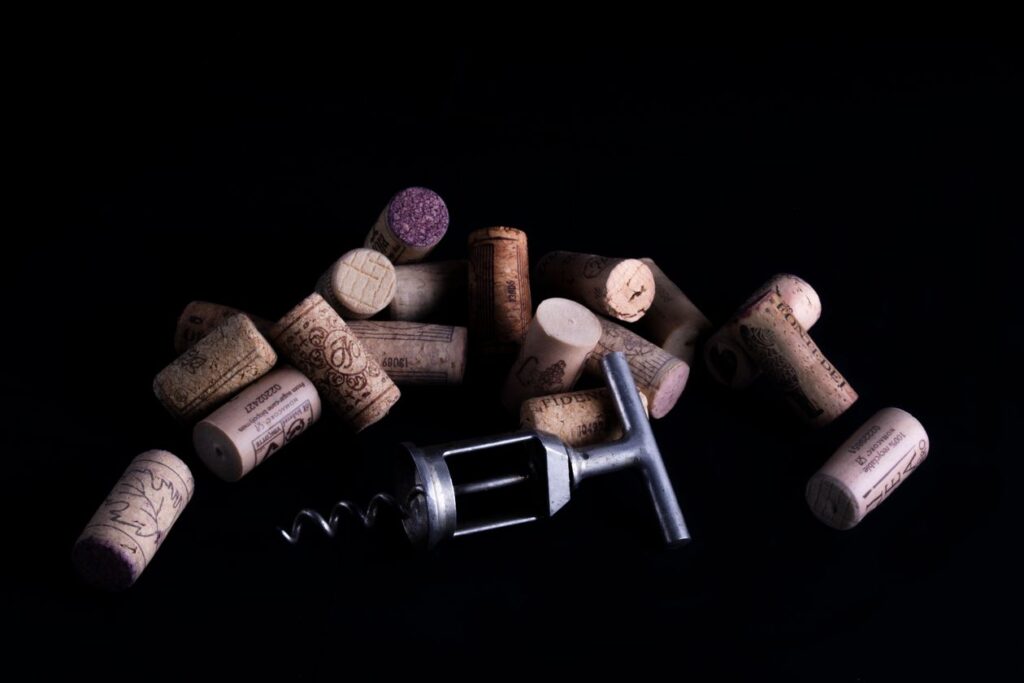
Old corks are the usual culprits because they dry out. Pull them slowly and straight up, or use a two-prong cork puller, which slides down the sides of the cork instead of piercing it.
Does a corkscrew work on synthetic corks?
Yes, but expect to use more effort. Synthetic corks are firmer than natural cork, and a sharp, open spiral grips them better than a thick, solid screw. Screw caps, of course, need no opener at all.
How do you open sparkling wine?
Not with a corkscrew. Remove the foil and loosen the wire cage, keep a hand or a towel on top of the cork from that moment on, point the bottle away from people and turn the bottle, not the cork, until the cork eases out. A champagne grip helps if a cork is stuck.
Looking for a wine opener?
Our wine openers page has a short list of waiter’s keys, winged, lever, electric and air-pressure openers still sold on Amazon, with what to check before buying each type. We have also reviewed two of them in detail: the Boomerang two-step corkscrew and the Cork Pops air-pressure opener.
As an Amazon Associate we earn from qualifying purchases.